BRAINS tHAT SING TOGETHER, RELAX TOGETHER
One of the ideas that sits at the heart of both neuroscience and human experience is that we are not designed to function entirely alone.
For a long time, the brain was often described as a kind of supercomputer, processing information independently and making decisions based on the data it received. Whilst there is some truth in that, modern neuroscience paints a much more social picture. Our brains are constantly shaped by, influenced by, and responding to the people around us.
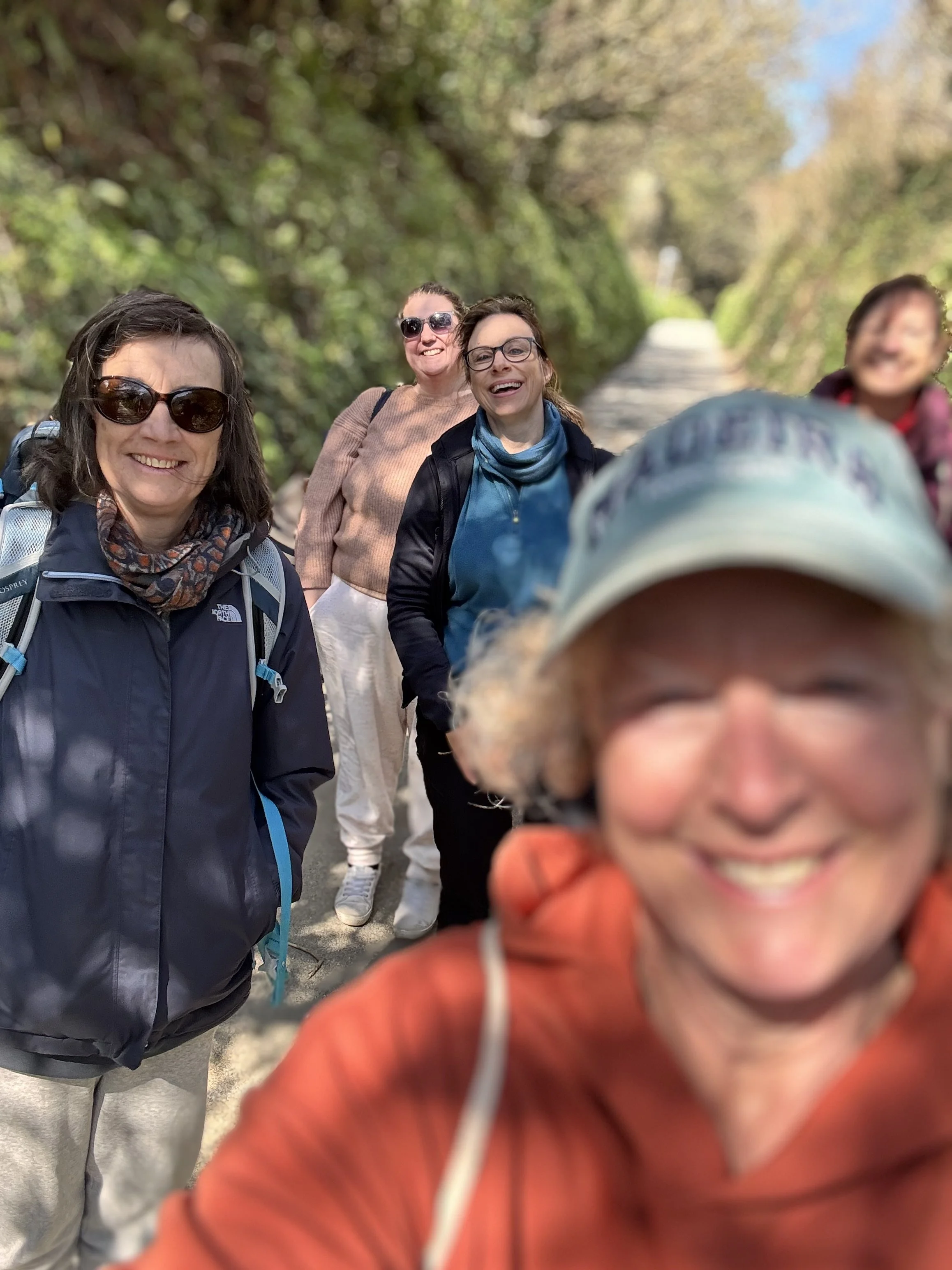
We’re better as a tribe than we are as individuals. Picture from one of my retreats in Devon.
Neuroscientist Lisa Feldman Barrett describes humans as a socially dependent species. Our brains are continually making predictions about the world, and one of the most important sources of information for those predictions is other people. We look to those around us, often without realising it, to determine whether we are safe, whether we belong, how we should respond, and even how we feel.
This helps explain why community matters so much.
When we spend time with people who are calm, welcoming and supportive, our nervous systems notice. We borrow reassurance from one another. We regulate one another. A smile, a nod of encouragement, shared laughter, a familiar voice or a feeling of being understood all provide information to the brain that says, "You are safe here."
Joint ventures, and activities that are shared, such as singing together - amplify this process.
COLLECTIVE EFFErVESCENCE
When a group sings, something remarkable happens. Breathing begins to synchronise. Attention becomes focused on a shared task. People listen to one another, adjust to one another and create something collectively that none of them could create alone. Researchers have found that singing together can lead to greater feelings of social closeness even among complete strangers.
The experience is often difficult to explain because We feel it more than analyse it. We just know that we love it!
People frequently leave a choir rehearsal, singing retreat or community singing session saying they feel lighter, calmer, more energised or more connected. They may assume this is simply because they enjoyed the music. In reality, they have been participating in a powerful form of social regulation. There is a phrase for the feeling and the synchrony - ‘collective effervescence‘- literally the sense of bubbling or fizzing together!
“We feel it - I feel it, every time we all sing together, it’s amazing :)”
Why Singing Matters More Than We Think
The anthropologist and evolutionary psychologist Robin Dunbar has suggested that activities such as singing may have evolved as a way of strengthening social bonds within groups. In a sense, singing helps a collection of individuals become a community.
Humans have sung together for thousands of years. Long before organised exercise classes, therapy groups, or social media, singing was one of the ways we connected, communicated, and created a sense of belonging. From a neuroscience perspective, singing is a whole-brain activity. It engages areas involved in emotion, memory, language, attention, movement, and social connection all at the same time.
Over the course of my life, I’ve sung in many different ways. At school we sang together at the start of the day. As a girl guide and ranger, we sang at our meetings and at campfires. Later, I sang in choirs, and now I sing for the simple joy of it as part of a group called SongBirds. We sing, often outside in a beautiful Devon woodland, unaccompanied and with no words or music, led by the wonderful Hope Buzza. Hope will be joining me for our Joy and Connection retreat in September to offer this beautiful way of singing to us all. This fits perfectly with the purpose of my wellness retreats, to help women connect with themselves and with nature to create confidence and calm.
Singing Helps Regulate the Nervous System
Singing naturally slows and deepens breathing, stimulating the vagus nerve and supporting activation of the parasympathetic nervous system (our rest and digest system - the one that regulates our heart rate, blood pressure and digestion) Activation of our parasympathetic nervous system helps us feel relaxed, safe and comfortable.
Longer out-breaths during singing can help shift us from a state of vigilance and stress towards one of safety and calm.
Many people describe feeling more settled after singing without realising that there is a biological reason for this.
Singing Creates Positive Emotion
Group singing has been linked with increased levels of dopamine, one of the brain's reward chemicals.
Dopamine is not simply the "feel-good" chemical. It helps us notice what is important, motivating us to repeat experiences that are beneficial.
Singing often combines pleasure, challenge, achievement, and connection, all of which support healthy dopamine activity.
Collective Effervescence
Sociologist Émile Durkheim used the term "collective effervescence" to describe the energy that emerges when people come together around a shared activity.
Neuroscience is increasingly helping us understand why these moments feel so powerful.
Whether singing around a campfire, in a choir, at a concert, or on a retreat, we experience ourselves as part of something larger than ourselves.
Singing Strengthens Social Bonds
Positive social interaction is one of the foundations of wellbeing and one of your Three Ps.
Singing creates opportunities for eye contact, shared attention, laughter, cooperation, and mutual encouragement. These experiences help build trust and strengthen relationships.
Feeling connected to others is associated with better physical health, better mental health, and greater resilience.
MY INVITATION TO YOU
I’d love you to come and experience a retreat where we sing together. In September 2026, Hope Buzza and I will be leading a wellness retreat together on the edge of Dartmoor in South Devon. We have created a program that combines the joy of singing with the joy of the natural world and we’d love you to be there. We have a maximum of 20 spaces, and 7 of those are taken already. The link to the retreat page is below.
You don’t need to ‘be able to sing’ . Hope has an incredible way of building beautiful songs from scratch. Even if you’ve never sung before, you can enjoy the feeling of being part of something amazing. I’ll be creating guided visualisations and short workshops to complement our singing, and we’ll take ourselves out into nature as much as we can.
Let go, be yourself, feel the joy.